
Should You Play with AI, and Should AI Play Your Game?

AI can be a great tool, but we shouldn't let it direct our games. Used well, it frees up time for the work that matters. Used carelessly, it pulls every game towards the same average. Here's where I think AI really helps developers, and where it can't, or shouldn't, replace them.
I run UX Ballistics, a game UX consultancy for the European market. My job is to watch people play games and find out why they get stuck, frustrated or quit. I also scout promising European games for publishers and investors, and I've spent 15 years in branding strategy and design. From each of these positions, I can see how fast AI is evolving and how it's impacting the industry. In games, it's not only a question of disruption, but also of its limits, ethics and legality. Game UX and playtesting are no exception.
AI runs out of breath when the player takes the wheel
AI is good at quick checklisting: taking the mechanics you describe and checking them against heuristic UX principles. Its limits start the moment a player gets behind the wheel.
That checklisting is exactly why we built the free AI UX Check tool. It lets developers quickly check their game idea against basic UX heuristics and get a general outlook on the risks their mechanics might run into. It gives them free first guidance before they start building, or before they invest more time and money in a long-term commitment. Beyond that free tool, we don’t use AI to interpret data in our testing. Everything is based on methods and strategies tailor-made for each project and its priorities. When AI does come in, it’s for specific cases, and we use it to collect more data, not to explain it.
Here's why. Players bring their biases to the table, and so do developers. We're humans, and our interaction with digital products, especially games, will never be perfect. That imperfection in human perception and interaction can make AI outputs misleading.
AI tries to be perfect, and understanding and balancing the nuances of many play styles, goals, emotions, fun and knowledge, all packed into one chaotic beauty, is where it gets tricky.
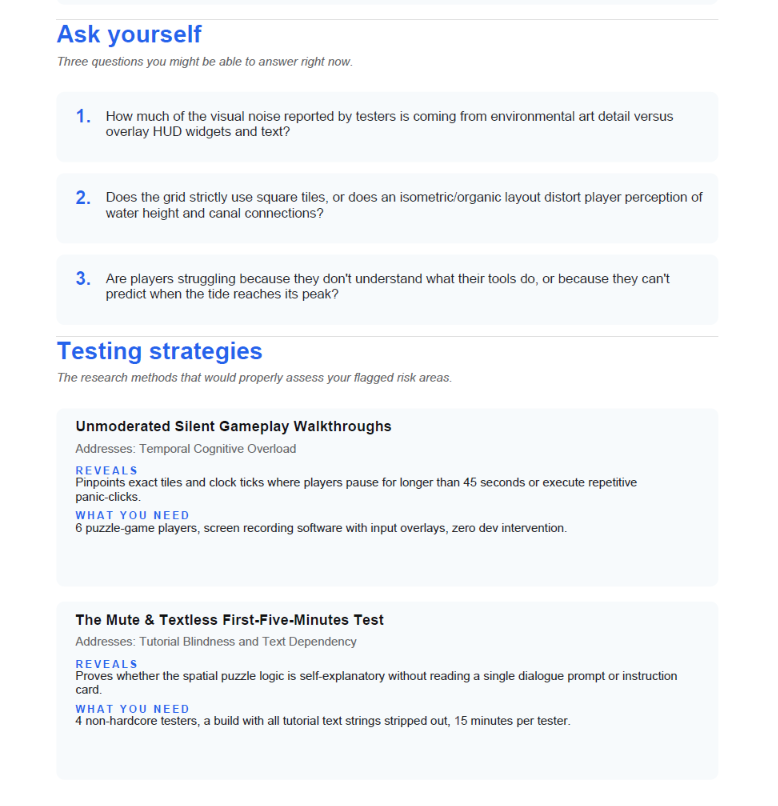 A sample from a UX Ballistics Pre-Check report, an AI assessment built on our audit framework.
The puzzle nobody could find
False affordances in combination with poor visual hierarchy are a good example of where a checklist falls short. Together they push up cognitive load, and an AI test alone won't uncover the cause. What is too much for a human to process, visually or mentally? AI is superior at reading huge amounts of data in a split second. But can we rely on it to estimate what is too much for a person? Can it recognize a player's learning curve, or the moment a player gets lost?
A few days ago, I was playing through the first minutes of an indie puzzle game. The world was rich: lots of assets, lots of colours, vertical movement and traversal everywhere. And I kept getting stuck. Not on the puzzles. On finding them. The developers tried to make it interesting to the point where they overdid it. They lost track of what actually mattered in the game: solving puzzles.
There were glowing objects with no interaction, weak feedback on important achievements, and important pieces of the puzzle lost in the rich environment. The fun of solving puzzles was quickly overshadowed by frustration.
I don't think AI, at today's stage, would understand the line between where the puzzle starts as a challenge and where it's just unnecessary frustration building up.
Finding the real trigger
AI can measure player behaviour up to a certain point, but a lot of details still go unnoticed. Frustration has many forms. Some players get angry, some feel stupid, some just stop playing because it's not fun anymore. Our job is to find not only that players feel that way, but what the real trigger of that behaviour or emotion was.
AI can't tell you if your game is fun
AI can point to general areas of a genre where developers should be cautious, but it can't determine whether something is fun or not.
You can add more AI tools for tracking, and they can show you where players repeat the same mistake. But it's still your job to identify the problem, translate it and recommend a solution. Data from a playtest is one thing. Translating it into fixes for the problems it represents is another.
The same goes for AI "players", the bots some studios now use to run through a game over and over. They're great for simulations and technical QA, like bugs and game performance. But AI players don't have emotions or human biases, so relying only on automated bots to test a game is shortsighted.
Some people will say it's convenient for a human playtester to argue this. I'm open to that discussion. I don't wear blindfolds, and I fully realize AI capabilities are evolving exponentially. I'm curious where the future will take us. But I haven't yet seen an AI playtest that covers human behaviour to the point where it solves the nuances of each player's unique imperfections.
From skeptic to toolmaker
When AI adoption started, I was skeptical about how fast it could grow. After one year, I was skeptical whether we could stop it, or even slow it down.
What surprised me most was how fast you can scale up your work efficiency. Today I use AI to build my own tools that fit my workflow. That experience shaped how I see AI's purpose in our industry.
A copy of a copy
Using AI as the main source of your artistic and creative input is a bad approach. It kills the main reason games are so amazing. If we stop being creative, everything turns into a copy of a copy, until there's nothing left.
Researchers already have a name for this kind of decay: model collapse. A 2024 study in Nature showed that when AI models are trained on content made by other AI, each new generation loses more of what was rare and original, until the output falls apart.
Using your own ideas, drawing your own assets, killing features and rebuilding them again: that's how you uncover something new. Something that can spark that feeling of discovery and fascination.
People have strong opinions about AI. You see developers bragging on social media: "I don't use AI, never AI in my work." I'm more open-minded. When a developer tells me they used AI, my question is: how did you use it? Did you develop new tools to get a better workflow or better efficiency? Did you use AI to create prototype variants to test how inputs feel? Did you use it for difficult calculations, or to solve a code problem? Well done.
AI art is a trust issue
Making an indie game is like an ancient craft that everyone respects.
With my background in branding, I don't have excessive expectations of the masses. Many players with preferences for certain genres or platforms won't even notice AI art. But the gaming community, especially in indie games, is more perceptive, and AI art can definitely discourage them.
Artists are facing their work being stolen to feed the AI vacuum, so there's an ethical and legal aspect to it as well.
That's why I think Steam did the right thing by asking developers to disclose AI-generated content that players see or hear in the game. Players want to know whether they're supporting the creativity of a person who handcrafted the game, or a game that used AI for its assets.
Can AI assets impact your outcome with publishers?
When I scout games for publishers and investors, AI art assets are thin ice. There would have to be a very specific reason to green-light that kind of game. Right now, I can't think of any reason, except maybe one specific case: feeding a model your own assets to build a novel mechanic or game loop.
AI used to build helpful tools and increase a team's efficiency is a different story. It shows the developers are already thinking about time management and resources, and that's crucial for any publisher or investor to consider.
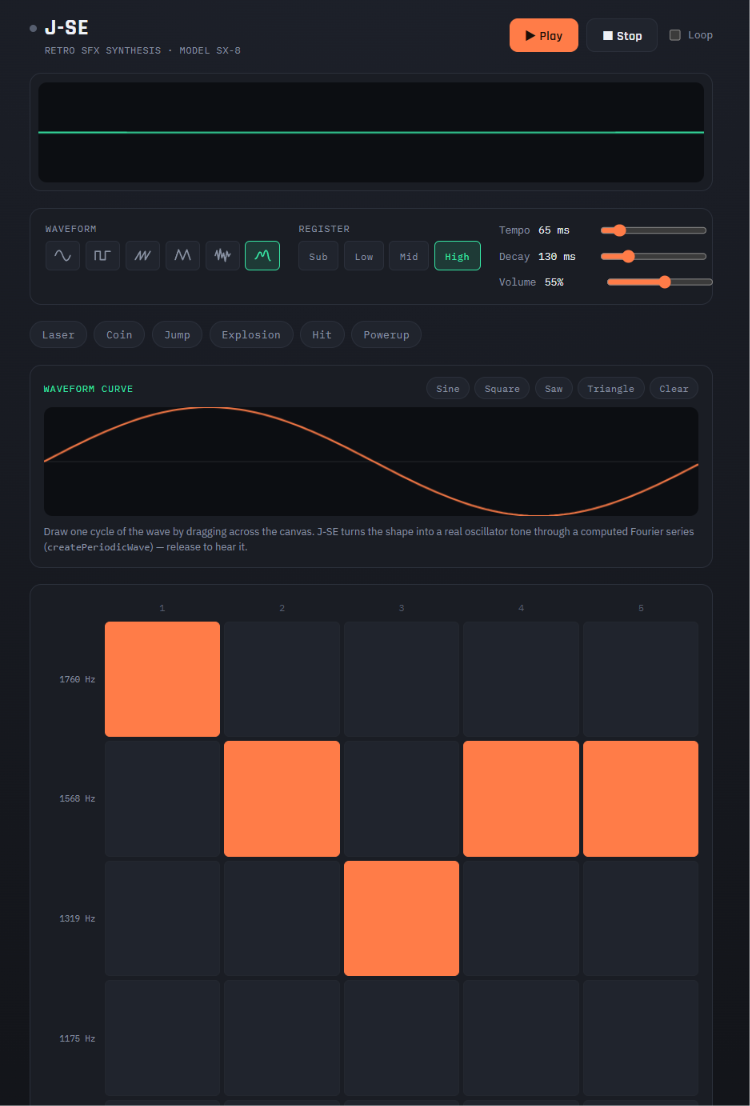 Example of a simple JavaScript sound editor built with an AI model.
Standing out in a flood of games
Being seen is getting harder and harder. More than 21,000 games came out on Steam in 2025, and 2026 has already passed 23,000, according to SteamDB. Indie developers have to work harder on marketing. But quality craft has always had the upper hand, and AI tools let developers invest their time in the parts of development that really matter.
Transparency is part of that craft. A Game Oracle analysis of nearly 10,000 Steam games released in 2025 found that games disclosing AI use got about half as many reviews as comparable games without it. Even so, hiding it is the bigger risk. If you're not transparent and your audience eventually finds out, you risk not only bad reviews, but also your reputation.
Interestingly, the study doesn't simply blame players. Its author suspects AI may be a symptom rather than the cause: studios often reach for it to cut costs and ship faster, and those shortcuts end up in the game.
And then there's the one thing AI can't give you, imperfection. I think imperfection is what unlocks space for new ideas: new solutions in game mechanics, and new, interesting ways to build and play games.
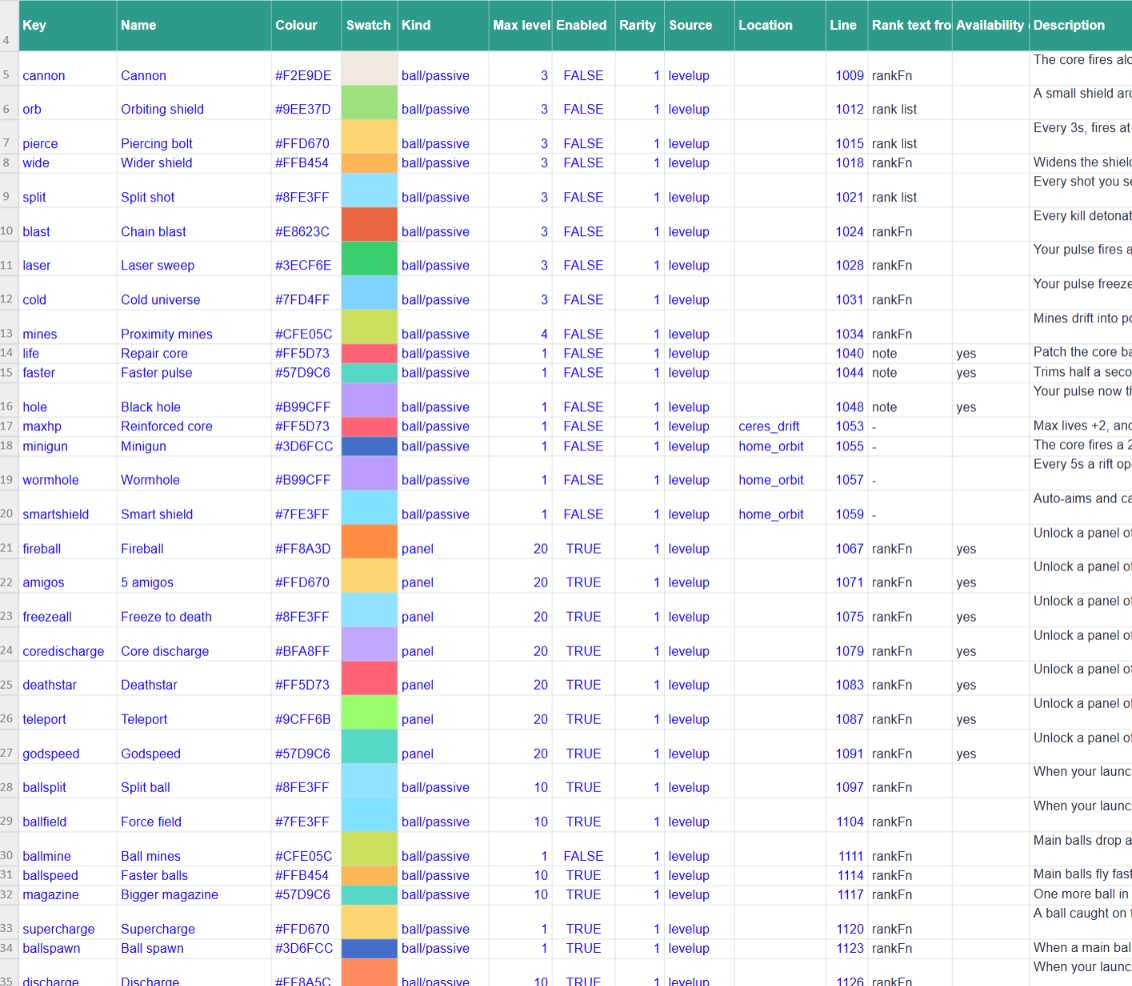 Ability data from a game prototype, pulled out with AI to meet the developer’s needs.
Where AI actually helps you build a game
Use AI where it saves you time, and keep the creative decisions for yourself. A few examples:
- Prototyping: when you test different controls or concepts, AI can quickly build many early prototypes. You describe how the controls should work, AI just implements them in the simplest way, and you test how they feel. Then you take over.
- Small tools around your development, especially if you're a solo developer: in-game level editors, sound editors to quickly tweak your audio, tools for file or data export.
- Simulations, spreadsheets and code: run simulations, build tables, check your code efficiency.
- Technical QA bots: automated runs that hunt for crashes, stuck states and performance drops.
- Accessibility checks: simulate colour blindness, check text contrast and size, and spot UI that relies on colour alone.
- Sorting playtest feedback: group hundreds of player comments or survey answers by theme, so patterns show up faster. Understanding why players struggle is still your job.
- Draft localization: AI can produce a first translation of your UI text, menus and item descriptions fast. But have a native speaker review it before release, because tone, humour and cultural context are where machine translation fails.
There's so much you can do and still keep your creative self.
I don't think there's any need for regret, as long as you know your audience, you're transparent in your communication, and you don't cross the ethical or legal line. Use AI as a toolkit that helps you increase your creative contributions, not as your director.